
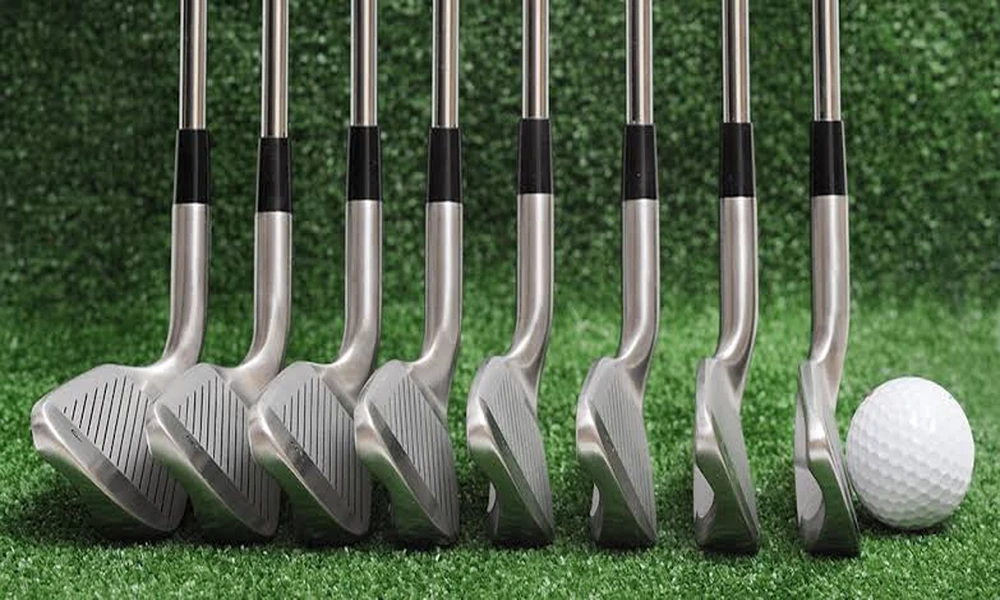
Wedge loft angles define what each club delivers from a given distance and lie. Knowing the degree range across wedge types helps golfers build a short game set with a club for every situation. Golfers researching golf wedges find that loft runs from around forty-four degrees to sixty-four degrees, with each wedge type sitting in a specific band. The sections below walk that spectrum from lowest to highest and explain how gap coverage works across a complete set.
Wedge loft degrees
- Pitching wedges sit at the lowest loft band, between forty-four and forty-eight degrees, depending on the iron set. Since manufacturing began making pitching wedges in the 1990s, lofts have risen to forty-four degrees on some models. As a result of that shift, golfers must carry an extra club meant to bridge the gap between clubs as they move from one set to the next. Most players hit their pitching wedge between one hundred and one hundred and thirty yards, with swing speed and strike quality moving that figure up or down.
- Gap wedges cover fifty to fifty-four degrees. Their purpose is direct: they fill the yardage window that the stronger pitching wedge opened up between itself and the sand wedge. Different brands name this club differently, approach wedge and attack wedge both appear on shelves, but the loft sits in the same range across all of them. Players who carry a gap wedge can swing fully for shots between eighty and one hundred and ten yards rather than guessing between clubs.
- There are fifty-four to fifty-eight degrees of slope on sand wedges. It’s partly because of a sand wedge’s wider sole and higher bounce angle that it prevents digging into soft ground like other clubs, which is why it’s so easy to play bunker shots with it. Players typically use sand wedges for greenside work rather than approach shots on firm fairway turf. They reach sixty to ninety yards on a full swing, although they can reach sixty to ninety yards on hard fairway turf.
- A lob wedge should be placed between fifty-eight and sixty-four degrees to close out the spectrum. When the flag sits close to a bunker or near the edge of a green, this type of golf ball climbs quickly and comes down softly. Golfers most frequently hit lob wedges for short shots around the green rather than full approach swings with a 60-degree wedge. However, a 60-degree wedge can travel forty to seventy yards at full speed.
Loft gap coverage
Building a wedge set that works starts with checking the loft on each club and noting the space between consecutive clubs. A set running from forty-six to sixty degrees in four-degree steps covers every yardage window with a reliable full swing option. When two consecutive wedges sit more than six degrees apart, that gap becomes a yardage the player cannot reach comfortably, and partial swings introduce more error than the short game can handle well. Checking those intervals once and adding a wedge wherever the gap runs wide removes that problem before it costs shots on the course.
Depending on distance window and shot type, wedge loft angles range from forty-four to sixty-four degrees. Wedge pitching is ideal for long approaches, gap wedges are ideal for modern distance holes, sand wedges are ideal for bunkers and short pitches, and lob wedges are great for landing softly. A consistent spacing across the set makes every yardage reliable and keeps the short game sharp.